
What is inulin?
Inulin is a naturally occurring prebiotic fiber found in chicory root, Jerusalem artichoke, garlic, onions, leeks, and bananas. Unlike most fibers, inulin is fermentable — meaning the beneficial bacteria in your gut break it down and produce compounds that affect your health in measurable ways.
Inulin is not a medication. It’s a dietary fiber supplement, widely available as an unflavored powder that dissolves easily in water, coffee, smoothies, yogurt, or cereal. It has a mildly sweet taste.
Why consider inulin?
There are two main reasons patients in our practice may benefit from inulin supplementation:
Appetite and weight management
A 2024 meta-analysis of 32 randomized controlled trials (over 1,100 participants) found that inulin-type fructans produced a mean weight reduction of approximately 1 kg, with greater effects at durations longer than 8 weeks (-1.3 kg). Participants also showed reductions in BMI, fat mass, waist circumference, and body fat percentage (Reimer et al., American Journal of Clinical Nutrition, 2024). These are modest but real effects — comparable to or better than most other fiber supplements studied.
The mechanism is straightforward: fermentable fiber increases satiety. Studies show inulin reduces hunger ratings and total calorie intake by roughly 10% at subsequent meals. Part of this effect may involve GLP-1, a gut hormone that regulates appetite — inulin supplementation has been shown to increase GLP-1 levels in some trials, though the degree to which this drives the weight effect in humans is not yet established.
Bottom line: inulin is not a weight-loss drug. It’s a fiber that genuinely helps you feel fuller, eat less, and supports modest but meaningful weight reduction when combined with reasonable dietary choices.
Anti-inflammatory potential
The INSPIRE trial (Kouraki et al., Nutrients, 2026) randomized 117 adults with knee osteoarthritis to receive either 20 g/day of inulin, digital physiotherapy, both, or placebo for six weeks. Inulin reduced knee pain comparably to physiotherapy — with no significant difference between the two arms. Notably, inulin also improved pressure pain thresholds and a measure of central pain sensitization, suggesting effects beyond local joint inflammation.
In a separate trial in rheumatoid arthritis patients (Tabatabaeyan et al., Scientific Reports, 2025), 10 g/day of inulin for eight weeks reduced CRP by 11.7 mg/L, improved DAS-28 scores, reduced tender and swollen joint counts, and improved grip strength compared to placebo (n=60).
The proposed mechanism: inulin feeds beneficial gut bacteria that produce short-chain fatty acids (SCFAs) — particularly butyrate, propionate, and acetate. Human studies confirm inulin increases butyrate production by roughly 40–50% (Kirschner et al., American Journal of Clinical Nutrition, 2025). Butyrate strengthens the intestinal barrier, reduces NF-κB signaling, and promotes anti-inflammatory pathways. Inulin also shifts the gut microbiome toward species like Bifidobacterium and Faecalibacterium prausnitzii that are associated with lower systemic inflammation.
Bottom line: the anti-inflammatory data is promising but still early. Two well-designed trials show real clinical improvement. This is not a replacement for your disease-modifying medications, but it may provide a meaningful ancillary benefit — and the risk is essentially zero for most patients.
How to titrate
Inulin causes gas, bloating, and abdominal discomfort when introduced too quickly. Your gut bacteria need time to adapt. The key is to start low and increase gradually.
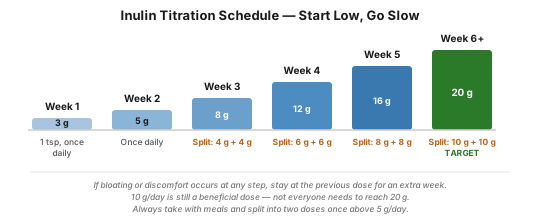
| Week | Daily dose | How to take it |
|---|---|---|
| 1 | 3 g (one teaspoon) | Once daily, mixed into food or a drink with a meal |
| 2 | 5 g | Once daily with a meal |
| 3 | 8 g | Split into two doses (4 g + 4 g) with meals |
| 4 | 12 g | Split into two doses (6 g + 6 g) with meals |
| 5 | 16 g | Split into two doses (8 g + 8 g) with meals |
| 6+ | 20 g (target) | Split into two doses (10 g + 10 g) with meals |
Important principles:
- Split your dose. Taking all 20 g at once is more likely to cause GI symptoms. Two doses with meals is better tolerated.
- Take it with food. Mixing inulin into a meal slows fermentation and reduces bloating.
- If you get significant bloating or discomfort at any step, drop back to the previous dose for another week before trying to advance again. There is no deadline.
- Not everyone will tolerate 20 g/day. If you plateau at 10–15 g with good tolerance, that’s still a beneficial dose. The RA trial showing CRP reduction used only 10 g/day.
What to buy
NOW Foods Organic Inulin Powder (chicory root-derived, pure inulin) is a reliable, affordable option. It’s unflavored, dissolves well, and contains nothing but inulin.
Other brands are fine — inulin is inulin. Look for:
- Pure inulin from chicory root (the most studied source)
- No added sweeteners, flavors, or fillers
- Reasonable price — inulin is a commodity fiber, not a specialty supplement. If a brand costs substantially more per gram, you’re paying for marketing, not quality.
A typical canister (8–12 oz) at 10–20 g/day will last 2–4 weeks and costs under $15.
What to expect
- Week 1–2: Increased gas and mild bloating are normal and expected. This typically improves as your gut microbiome adjusts.
- Week 2–4: Most patients notice the GI symptoms settling. You may begin to notice feeling fuller after meals.
- Week 4–8: If you’re going to notice appetite or satiety changes, this is when they typically become apparent. Anti-inflammatory benefits in clinical trials were measured at 6–8 weeks.
- Ongoing: The microbiome changes (increased beneficial bacteria, increased SCFA production) are maintained as long as you continue taking inulin. If you stop, the microbiome gradually reverts.
A note for patients with IBS
Inulin is a fructan, which is a type of FODMAP. If you have IBS or are sensitive to FODMAPs, inulin may worsen bloating, cramping, or diarrhea — especially at higher doses. This doesn’t mean you can’t try it, but proceed more cautiously: start at 2 g/day, increase by 1–2 g per week, and back off if symptoms worsen beyond mild discomfort. If inulin consistently aggravates your GI symptoms even at low doses, it may not be the right supplement for you.
Frequently asked questions
Can I get enough inulin from food alone? In theory, yes — but in practice, reaching 20 g/day from food is difficult. You’d need to eat large quantities of chicory root, Jerusalem artichoke, or raw garlic daily. A supplement is the practical way to reach therapeutic doses. That said, eating inulin-rich foods (onions, garlic, leeks, bananas) in addition to supplementing is a good habit.
Does inulin interact with my medications? Inulin has no known clinically significant drug interactions. It is a fiber, not a drug. However, because it can affect gut motility and absorption timing, take it with meals rather than at the same moment as critical medications if you want to be cautious.
Is this a substitute for my rheumatology medications? No. Inulin is a dietary supplement that may provide a modest ancillary benefit. It does not replace disease-modifying therapy, biologics, or any medication we have prescribed.
How long should I take it? There is no defined endpoint. If you tolerate it well and find it helpful, it can be taken indefinitely. If you stop, the gut microbiome changes reverse over weeks.
What if I can’t get past 10 grams without discomfort? Stay at the dose you tolerate. Ten grams per day was the dose used in the RA trial that showed significant CRP reduction and clinical improvement. More is not always necessary.
This handout is provided for educational purposes and does not replace individualized medical advice. Always follow the specific instructions given by your rheumatologist.