
Why treatment matters
Osteoporosis is often called a “silent disease” because you won’t feel your bones weakening. The first sign might be a broken bone after a minor fall or bump. While many fractures heal, they can cause significant pain and lasting disability.
Hip fractures are particularly serious. Roughly one in four patients who fracture a hip do not survive the first year — and mortality remains elevated for years afterward. This is due to complications from emergency surgery and the difficult, prolonged recovery that can lead to other health problems.
By treating osteoporosis effectively, we aim to prevent these fractures before they occur, keeping you active, independent, and healthy.
Foundations for everyone
These strategies are important for all patients, regardless of which medication you take:
- Calcium: Aim for about 1,200 mg daily through diet and supplements combined
- Vitamin D: Take at least 1,000 IU daily (your doctor will adjust based on your blood levels). A target vitamin D level of 40 ng/mL is ideal for bone health.
- Vitamin K2: Consider supplementing up to 100 mcg daily to help direct calcium to your bones
- Weight-bearing exercise: Walking, resistance training, or similar activities at least twice weekly
- Avoid smoking: Smoking accelerates bone loss and interferes with treatment
- Fall prevention: Remove tripping hazards at home, maintain good lighting, and address balance or vision issues
- DEXA scans: Repeat bone density testing every 2 years to monitor your response to treatment
Understanding your medication options
Osteoporosis medications fall into two main categories: bone stabilizers that slow bone loss and bone builders that actively create new bone.
Bone stabilizers (antiresorptives)
These medications reduce the activity of osteoclasts — the cells that break down bone — allowing your body to hold onto the bone it has.
Bisphosphonates
Bisphosphonates are the most commonly prescribed osteoporosis medications and have a decades-long track record.
Oral bisphosphonates (alendronate, risedronate):
- How you take it: Weekly tablet on an empty stomach with a full glass of water. Stay upright for at least 30 minutes afterward — do not eat, drink anything else, or lie down.
- How long: Typically 3–5 years, then your doctor may recommend a “drug holiday” depending on your fracture risk. The medication continues to work for some time after you stop.
- How well it works: Reduces vertebral and hip fracture risk by approximately 50%.
- Common side effects: Stomach upset, heartburn, or esophageal irritation — reported in roughly 5–10% of patients. The enteric precautions (empty stomach, staying upright) help prevent this.
- Rare but serious: Osteonecrosis of the jaw (ONJ) — see the dental section below. Atypical femur fractures are extremely rare and associated with very prolonged use, which is why we reassess after several years.
Zoledronic acid (Reclast) infusion:
- How you take it: A single 15-minute IV infusion once a year, given in our office.
- How long: Typically 3–6 years before reassessment.
- How well it works: Reduces vertebral fracture risk by approximately 70% and hip fracture risk by approximately 40%.
- Common side effects: Flu-like symptoms (fever, muscle aches, fatigue) in the 24–72 hours after the first infusion, affecting roughly 30% of patients. This reaction is much less common with subsequent annual doses and can be managed with acetaminophen. Staying well-hydrated before and after the infusion helps.
- Rare but serious: Same ONJ and atypical fracture considerations as oral bisphosphonates.
Denosumab (Prolia)
- How you take it: An injection under the skin every 6 months, given in our office by our medical assistant staff.
- How long: This is a long-term, ongoing medication. Unlike bisphosphonates, denosumab does not build up in bone — its effects wear off when you stop, and bone loss can rebound rapidly. Do not stop denosumab without a plan. If we discontinue it, we transition you to a bisphosphonate to protect the bone density you’ve gained.
- How well it works: Reduces vertebral fracture risk by approximately 68% and hip fracture risk by approximately 40%.
- Common side effects: Joint pain, back pain, or muscle pain — reported in roughly 5–10% of patients.
- Rare but serious: Similar ONJ risk as bisphosphonates. The rebound bone loss after stopping is the most important practical concern.
Bone builders (anabolics)
These medications actively stimulate new bone formation and are usually reserved for patients at higher fracture risk — such as those with very low T-scores (below -3.0), prior fractures, or fractures despite being on a bone stabilizer.
Teriparatide (Forteo) and abaloparatide (Tymlos)
- How you take it: Daily self-injection with a small pen device at home — similar to an insulin pen.
- How long: Limited to 2 years of use in your lifetime.
- How well it works: Reduces vertebral fracture risk by 65–86% depending on the agent. These are among the most effective osteoporosis treatments available.
- Common side effects: Dizziness, leg cramps, or nausea — affecting roughly 10–15% of patients, usually mild.
- What happens next: After completing the 2-year course, you must switch to a bone stabilizer (typically a bisphosphonate or denosumab) to maintain the new bone you’ve built. Without this transition, the gains can be lost within 1–2 years.
Romosozumab (Evenity)
- How you take it: Two injections (given together) once a month for 12 months, administered in our office.
- How long: A single 12-month course — it is not repeated.
- How well it works: Rapidly builds new bone while simultaneously reducing bone breakdown — a dual mechanism unique among osteoporosis treatments.
- Common side effects: Joint pain, headache — reported in roughly 5–10% of patients.
- Important caution: Not recommended for patients who have had a heart attack or stroke within the past year. Your doctor will assess cardiovascular risk before prescribing.
- What happens next: Like other bone builders, romosozumab is followed by a bone stabilizer to maintain the benefit.
A note about dental procedures and ONJ
Many patients worry about osteonecrosis of the jaw (ONJ) — a rare complication linked to bisphosphonates and denosumab. Here’s what you should know:
- ONJ is associated with invasive dental procedures — extractions, implants, root canals, and bone surgery — not routine cleanings, check-ups, or fillings.
- The risk for osteoporosis patients is extremely low: approximately 1 in 10,000 to 1 in 100,000 patients. (The higher ONJ rates you may see reported are from cancer patients receiving much higher doses of these drugs.)
- Your dentist simply needs to know you’re taking one of these medications so they can plan accordingly.
- For perspective, your risk of fracture without treatment is far greater than your risk of ONJ with treatment. This should not be a reason to avoid effective therapy.
How we choose a treatment
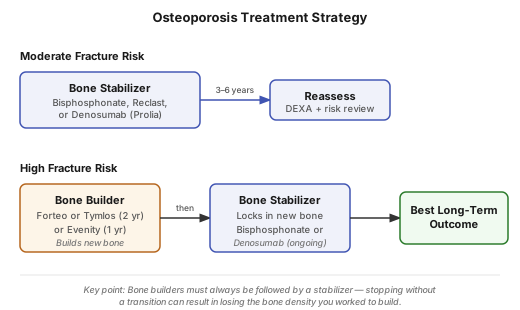
Your doctor will recommend a plan based on your specific situation:
- For most patients with moderate risk, a bone stabilizer — oral bisphosphonate, zoledronic acid infusion, or denosumab — is the first step.
- For patients at higher risk (very low T-scores, prior fractures, or fractures on existing therapy), we often start with a bone builder for its limited treatment course, then transition to a stabilizer to lock in the gains.
- Combination or sequential therapy — starting with a builder and following with a stabilizer — produces the best long-term outcomes for high-risk patients.
Why we don’t start everyone on a bone builder
Bone builders like Evenity, Forteo, and Tymlos are powerful medications, and patients understandably ask why we don’t use them first for everyone. There are several reasons:
- They have a lifetime cap. Forteo and Tymlos are limited to 2 years total — ever. Evenity is a single 12-month course. Once you’ve used your window, it’s gone. If we use a bone builder when a stabilizer would have been sufficient, that option is no longer available later if your situation worsens.
- Stabilizers work well for most patients. For moderate-risk osteoporosis — a T-score around -2.5 without prior fractures — bisphosphonates and denosumab reduce fracture risk by 40–70%. That’s excellent. Bone builders are reserved for when we need more than what stabilizers can deliver.
- They must be followed by a stabilizer anyway. A bone builder without a stabilizer afterward loses its benefit within 1–2 years. Every patient who starts a builder still ends up on a stabilizer — so the question is whether you need the builder first, not whether you can skip the stabilizer.
- Cost and logistics. Bone builders are significantly more expensive and require daily self-injection (Forteo/Tymlos) or monthly office visits (Evenity). For patients whose fracture risk doesn’t warrant that burden, a simpler regimen is the better choice.
In short: bone builders are the strongest tools we have, and we want them available when you need them most. Using them too early is like deploying your reserve forces in a battle you were already winning.
Your treatment plan will also take into account your other medical conditions, medications, preferences about injection versus oral therapy, and insurance coverage.
Your next steps
- Discuss with your doctor which medication fits your specific situation
- Implement the foundations — calcium, vitamin D, exercise, and fall prevention
- Tell your dentist you’re on an osteoporosis medication
- Keep track of how you feel and report any concerns promptly
- Schedule your follow-up DEXA scan in approximately 2 years
This handout is provided for educational purposes and does not replace individualized medical advice. Always follow the specific instructions given by your rheumatologist.