
Start planning early
If you’re thinking about becoming pregnant — even if it’s months or a year away — tell us now. Pregnancy with rheumatic disease requires planning, and the best outcomes happen when we have time to prepare.
Ideally, we want 3–6 months before conception to adjust medications, confirm disease control, check relevant antibodies, and coordinate with your OB or maternal-fetal medicine (MFM) specialist. Surprises aren’t ideal in this setting — the more lead time, the better.
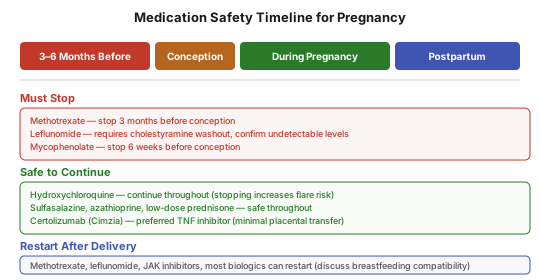
Medications that are safe during pregnancy
Several medications used in rheumatology have strong safety data in pregnancy. These don’t need to be stopped — and in some cases, stopping them would be a mistake:
- Hydroxychloroquine (Plaquenil) — continue this medication; it reduces lupus flare risk during pregnancy and has an excellent safety profile; stopping it increases flare risk significantly
- Sulfasalazine — considered safe throughout pregnancy; folic acid supplementation (which you should already be on) is especially important
- Low-dose prednisone (≤10 mg/day) — acceptable when needed for disease control; we aim for the lowest effective dose
- Azathioprine (Imuran) — compatible with pregnancy at standard doses; used when ongoing immunosuppression is needed
- Certolizumab (Cimzia) — the preferred TNF inhibitor during pregnancy because its unique structure results in minimal placental transfer to the baby
- Tacrolimus — used in selected situations, compatible with pregnancy
Do not stop all your medications because you’re planning to conceive. Uncontrolled disease during pregnancy is a greater risk to both you and your baby than most of the medications listed above.
Medications that must be stopped before conception
Some medications are teratogenic — they can cause birth defects or pregnancy loss — and must be discontinued well before conception:
- Methotrexate — must be stopped at least 3 months before conception (both women and men); this is non-negotiable
- Leflunomide (Arava) — requires a formal cholestyramine washout procedure because it has an extremely long half-life; blood levels must be confirmed undetectable before conceiving
- Mycophenolate (CellCept/Myfortic) — must be stopped at least 6 weeks before conception; associated with specific birth defect patterns
- JAK inhibitors (tofacitinib, upadacitinib, baricitinib) — insufficient human safety data; must be stopped before conception
- Cyclophosphamide — teratogenic and can cause infertility; must be stopped well in advance
- Most other biologics — require individual discussion; some are stopped in the third trimester, others are continued; we’ll make a specific plan for your situation
Disease control matters — a lot
This is the most important concept in this handout: pregnancy outcomes are best when your disease is well-controlled BEFORE conception.
Active disease during pregnancy increases the risk of:
- Preterm delivery
- Preeclampsia — especially in lupus patients
- Fetal growth restriction
- Pregnancy loss
- Postpartum flare
The solution is not to stop all medications and hope for the best. The solution is to transition to pregnancy-compatible medications, confirm your disease is stable, and then proceed. Rushing into pregnancy during active disease — or stopping medications without a plan — puts both you and your baby at unnecessary risk.
Lupus-specific considerations
Pregnancy in lupus requires extra attention:
- Anti-SSA (Ro) and anti-SSB (La) antibodies — if you carry these antibodies, there is a small risk of neonatal lupus in the baby, including a rare but serious risk of congenital heart block; monitoring with fetal echocardiography between weeks 16–26 is recommended
- Antiphospholipid antibodies — if present, you may need low-dose aspirin and possibly heparin during pregnancy to reduce the risk of clotting complications and pregnancy loss
- Hydroxychloroquine is protective — it reduces lupus flare risk during pregnancy and may reduce the risk of neonatal heart block in anti-SSA positive patients; do not stop it
- Kidney function — if you have a history of lupus nephritis, we’ll monitor your kidney function closely throughout pregnancy
- For more detailed information on lupus and pregnancy, lupuspregnancy.org is an excellent patient resource maintained by researchers specializing in this area
How we coordinate your care
You won’t be doing this alone. Pregnancy in rheumatic disease is a team effort:
- We work directly with your OB/GYN or maternal-fetal medicine specialist to co-manage your care throughout pregnancy and the postpartum period
- We’ll see you regularly during pregnancy — typically every 4–8 weeks depending on your condition and disease activity
- We adjust medications as needed at each trimester, balancing disease control with fetal safety
- The postpartum period is high-risk for flare — we’ll have a plan for restarting or adjusting medications after delivery
Breastfeeding — more options than you think
Many patients assume they’ll have to choose between breastfeeding and restarting their medications. In most cases, that’s not true.
- Hydroxychloroquine, sulfasalazine, azathioprine, and low-dose prednisone are all compatible with breastfeeding
- Most TNF inhibitors are considered compatible — large molecules transfer minimally into breast milk
- Methotrexate and leflunomide should NOT be used while breastfeeding
- We’ll discuss your specific medication plan before delivery so you know exactly what’s safe
For male patients
Pregnancy planning isn’t only a female patient issue. Several rheumatology medications affect male fertility and require discussion:
- Methotrexate — stop at least 3 months before your partner attempts to conceive
- Sulfasalazine — causes reversible reductions in sperm count and motility; discuss timing with us
- Cyclophosphamide — can cause permanent infertility in men; sperm banking should be discussed before starting this medication at any age
- JAK inhibitors — limited data on male fertility effects; discuss individually
The bottom line
Having a rheumatic disease does not mean you can’t have a healthy pregnancy. It means you need a plan. Start the conversation early, don’t stop medications without guidance, and let us coordinate with your obstetric team. The vast majority of our patients who plan carefully have successful pregnancies and healthy babies.
This handout is provided for educational purposes and does not replace individualized medical advice. Always follow the specific instructions given by your rheumatologist.