
What makes this different from a regular prescription
We’ve prescribed a specialty medication — a biologic, JAK inhibitor, or other advanced therapy — to treat your condition. These medications are among the most effective tools in rheumatology, but they work differently from the prescriptions you pick up at a local pharmacy. They require insurance pre-approval, are dispensed through specialized pharmacies, and often need refrigeration and special handling.
This guide walks you through the entire process from prescription to your first dose.
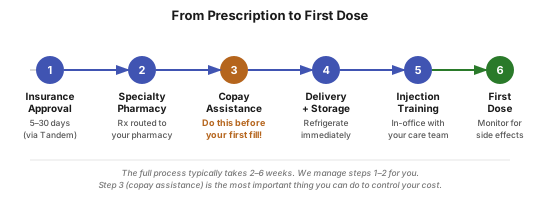
Step 1: Insurance approval (prior authorization)
Because these medications are high-cost, your insurance company must approve their use before they’ll cover it. This is called a prior authorization (PA).
How we handle it:
- We use a service called Tandem to manage the prior authorization process for you
- You will receive text messages from Tandem with status updates — when your PA is submitted, approved, denied, or if additional steps are needed. Your information is not sold or shared.
- In California, insurance companies are legally required to make a decision within 5 business days
- If we submit an urgent request, most insurers must respond within 24 to 72 hours
If your insurance denies the request:
Denials are common and are frequently overturned. A denial does not mean your doctor was wrong — it means the insurance company needs more convincing.
- The insurer may want you to try a cheaper medication first (step therapy). If that requirement doesn’t make medical sense for your situation — because you’ve already tried and failed the required drug, have a contraindication, or your disease is severe enough to skip ahead — we advocate for an exception.
- We handle appeals through Tandem, including peer-to-peer reviews where your doctor speaks directly with the insurer’s medical reviewer. Appeals can take up to 30 days.
- You can contact our office at any time to check the status of your authorization.
Step 2: The specialty pharmacy
Once approved, your prescription goes to a specialty pharmacy. This is not your usual CVS or Costco — these are specialized mail-order pharmacies equipped to stock, store, and ship these medications. Common ones include CVS Specialty, Accredo, Express Scripts, and Optum Specialty.
- Our preferred local pharmacies are Walgreens Specialty Pharmacy in La Jolla and Alpida Pharmacy in Oceanside — they’re local, responsive, and deliver faster than the national mail-order chains
- For most insurance plans, we do not control which specialty pharmacy is used — insurers often lock prescriptions to a specific pharmacy. If this happens, the pharmacy will contact you directly.
- Regardless of which pharmacy fills your prescription, the medication will be shipped directly to your door or delivered by local courier
Step 3: Copay assistance — do this before your first fill
This is the most important step in this handout.
Without copay assistance, specialty medications can cost $1,000–$2,000+ per month out of pocket. With assistance, your cost usually drops to less than $50 — and often $0.
How to enroll
- Check for a link from Tandem — after your medication is approved, Tandem will often text you an enrollment link for the copay assistance program
- Or search online — Google “[name of your drug] copay assistance” (e.g., “Enbrel copay assistance”) and follow the manufacturer’s enrollment form
- Fill out the form — you’ll need your name, address, and date of birth. You’ll receive a card number and group number
- Save these numbers and give them to the specialty pharmacy when they call to schedule your first delivery
Financial warning
If the pharmacy ever asks you to pay more than $50 for your medication:
- Do not pay it. Stop the transaction.
- Call our office immediately at (760) 891-4687.
A high copay ($200, $500, etc.) almost always means the copay card was not applied correctly or there’s a processing error at the pharmacy. If you pay a high amount, you likely will not get your money back. Let us troubleshoot it before you pay.
Step 4: Delivery and storage
- The package — your medication will arrive in a chilled cooler box (unless it’s an oral medication like Rinvoq or Otezla, which ships normally)
- Unpack immediately — open the box and place the medication in your refrigerator right away
- Do not freeze — freezing destroys biologic medications; if it freezes, it must be discarded
- Travel — room temperature stability varies by medication (from a few hours to 30 days). Check with our office or refer to our Traveling on Immunosuppression handout for a reference table before traveling with your medication. Keep it in your carry-on bag with the prescription label visible — never in checked luggage.
Step 5: Self-injection (for at-home injectable medications)
If your medication is self-injected, your care team will train you in the office before your first dose. Use this as a reminder checklist:
- Warm it up — take the pen or syringe out of the fridge 30 minutes before injecting. Cold medication stings; room temperature is much more comfortable.
- Choose your site:
- Abdomen — at least 2 inches away from your belly button
- Front of thigh — the middle, fleshy part (avoid the inner thigh)
- Rotate sites with each injection
- Clean the skin with an alcohol swab and let it air dry
- Inject — remove the cap, place the device flat against your skin at a 90-degree angle, and press the button or push down to start
- Hold for 15 seconds — even after you hear a click, keep the device against your skin for a slow count of 15 to ensure you receive the full dose
- Dispose — place the used device immediately into a sharps container (available at any pharmacy or online). Check your local trash service or search for a free sharps drop-off location near you.
Step 6: What to watch for
Common and expected:
- Injection site reactions — a red, itchy bump at the injection site is normal, especially with your first few doses. Ice and acetaminophen (Tylenol) help. These usually fade within a day or two and improve over time.
Call our office if you experience:
- Fever, chills, or signs of infection
- A reaction that worsens or doesn’t resolve within a few days
- Any side effects that concern you
Call 911 or go to the ER if you experience:
- Difficulty breathing or throat tightness
- Chest pain
- Severe rash or hives spreading across your body
For non-emergency questions or concerns, call our office at (760) 891-4687. You can speak with staff or leave a voicemail during or after business hours — voicemails left in the evenings and on weekends are checked promptly.
This handout is provided for educational purposes and does not replace individualized medical advice. Always follow the specific instructions given by your rheumatologist.